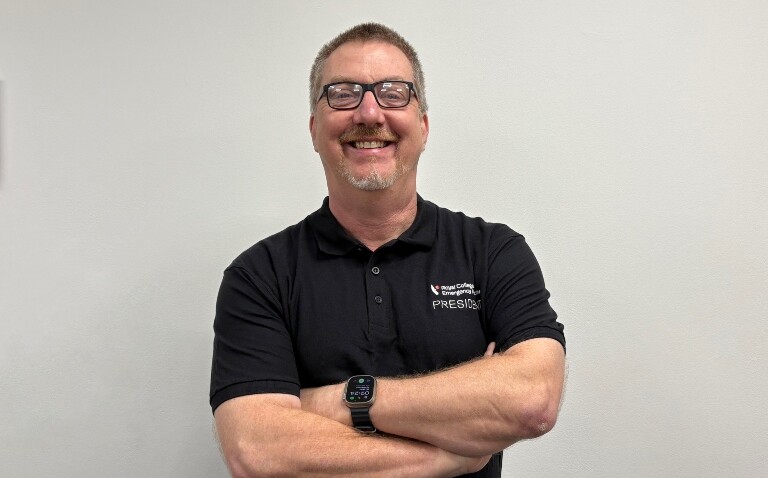
As his term as president of the Royal College of Emergency Medicine commences, Dr Ian Higginson advocates for investment, structural reform and space for clinicians to innovate, as Saša Janković explains.
When Dr Ian Higginson stepped into the role of president of the Royal College of Emergency Medicine (RCEM) in September 2025, he did so with decades of clinical experience and a deep, personal commitment to the speciality.
A consultant in emergency medicine with a particular interest in paediatric emergency care, Dr Higginson originally trained as a GP before discovering that the fast-paced environment of emergency medicine aligned more closely with his personality and professional motivations.
Now leading the RCEM at a time of intense pressure on urgent and emergency services, he acknowledges that emergency departments (EDs) ‘continue to face serious challenges around capacity, flow and staffing’. Nonetheless, he points to significant advances that have helped to support clinical practice and improve patient care.
‘I do not think anybody would claim that we are perfect, but we have come a long way thanks to improvements in quality standards, a maturing training pathway and a more stable professional identity and strengthened collaboration across the urgent and emergency care system,’ he says. ‘Yes, there is still a huge amount to do, but we have built a foundation to keep moving forward.’
Ongoing challenges in emergency medicine
Dr Higginson’s predecessor at the RCEM, immediate past president Dr Adrian Boyle, warned his successor would face ‘crowding, an increasingly disaffected workforce and governmental apathy towards urgent and emergency care’. But none of this comes as a surprise.
‘The major problem in emergency medicine remains crowding in EDs, which is caused predominantly by a lack of beds,’ Dr Higginson explains, ‘meaning patients are suffering because the wider system cannot move people through to beds or into community and social care quickly enough.’
A further challenge is workforce shortages, with ‘departments and staff often expected to tolerate conditions that wouldn’t be accepted elsewhere in the system’. As a result, the RCEM is pushing ahead with its ‘core work in training, standards and supporting high-quality care’ to protect staff as much as possible.
Dr Higginson is clear that lasting improvement will require proper investment in capacity, social care and the workforce. He argues that leaders must stop delaying and ‘make a start on solutions even if they are long term’. And while he sees opportunities in technology, artificial intelligence (AI), telemedicine and diagnostics, he says that it is ‘really, really hard to do that in overcrowded EDs’ and that many restrictions ‘come back to crowding and staffing’.
Workforce pressures in ED
It’s no secret that workforce pressures are being felt across specialities and the NHS, with a recent General Medical Council survey showing that burnout rates were highest among ED professionals.
As Dr Higginson explains, this is not a new problem, but one that is becoming more visible as the speciality matures. ‘Those of us who started when emergency medicine was getting underway are now getting older, and what we’re seeing is a larger number of these people choosing to either work flexibly, to work less than full time, to retire early, or to leave the profession early,’ he says.
‘Indeed, across Europe there’s an increasing tendency for emergency medicine professionals to work less than full time, and it’s likely that is not a career or generational choice, but a measure to improve the sustainability of their work. So, then you’re left with a workforce who are essentially having to work less at their job in order to survive their job.’
This pressure on staff is causing many in the speciality to leave, which can further exacerbate workforce issues. For Dr Higginson, ‘the cornerstone of staffing anything is retaining your staff’, and this is what he strives to support.
‘Space, stuff and staff’
A recurring theme for Dr Higginson is the need for a deeper understanding of emergency medicine from those who shape policy and allocate resources.
‘Emergency medicine as a speciality still has an enormous amount to offer the health system and our patients,’ he says. ‘It’s stuffed full of really quite brilliant people and attracts some of the best of the best. Yet despite this, we are still coming up against what feels like almost apathy from Government when it comes to tackling entrenched problems such as crowding and workforce pressures.’
As such, his message to colleagues, policymakers and the public is simple: emergency care is essential, and the people who deliver it need the right conditions to succeed. ‘We understand that there’s a need for good emergency care, and that good emergency care can both save lives and also reduce morbidity and mortality for patients if they’re treated properly early on,’ Dr Higginson explains.
‘To do that, you need a smoothly functioning system that can deliver care when patients need it, which means we need space, stuff and staff. That means physical capacity, properly designed facilities, access to beds to avoid crowding, and the information systems and equipment to work effectively. We don’t need to be told how to do our jobs; we need to be given the opportunity, the space and the resources to do our job well.’
Empowerment and progress through RCEM
To make positive progress, he argues that those in power must first recognise the problem, then commit to real solutions. ‘Too often, leaders look at this problem and say it’s too difficult to solve, but the way forward requires investment in hospital and social care capacity and a willingness to begin long term reforms even if they take time to bear fruit,’ he says. ‘The scale of this problem is big and that can be daunting, but that does not mean you do not start.’
Unsurprisingly then, Dr Higginson’s mindset for the three-year tenure of his presidency is ‘to make a start’ even on the most entrenched challenges.
As for his initial priorities, he emphasises the importance of maintaining the RCEM’s core work. ‘We need to continue with our main focus on training, standards, exams, CPD and research, while at the same time strengthening our advocacy around crowding and workforce – especially among the forthcoming changes to NHS England’s structure,’ he says.
Preparing for the future of emergency medicine
Looking further ahead, through RCEM, Dr Higginson wants to build on the identity and authority of the speciality, and is clear that emergency medicine will continue to evolve in response to both opportunity and threat.
‘We are enthusiastic about advances in telemedicine, diagnostics and imaging, and the role of AI in areas such as ambient clinical notetaking and ECG and imaging interpretation,’ he says. ‘But these tools will only be fully realised when basic information technology in the NHS catches up.’
At the same time, he says emergency departments must also prepare for wider global pressures. ‘We have to look forward at what quality of care looks like in the future and also think about how we prepare for potential difficulties,’ he says, citing conflict, the climate crisis and future pandemics as key risks.
There may be significant challenges facing the speciality, but his optimism rests with the people doing the work. Emergency physicians, he says, are ‘naturally forward-thinking, optimistic, active people who want to get stuff done’. It’s a speciality ‘stuffed full of innovators’ and there is ‘no question that the instinct to “move fast and break things” – applied constructively – is one of emergency medicine’s greatest strengths, provided leaders give clinicians the opportunity, the space and the resources to do our job well.’