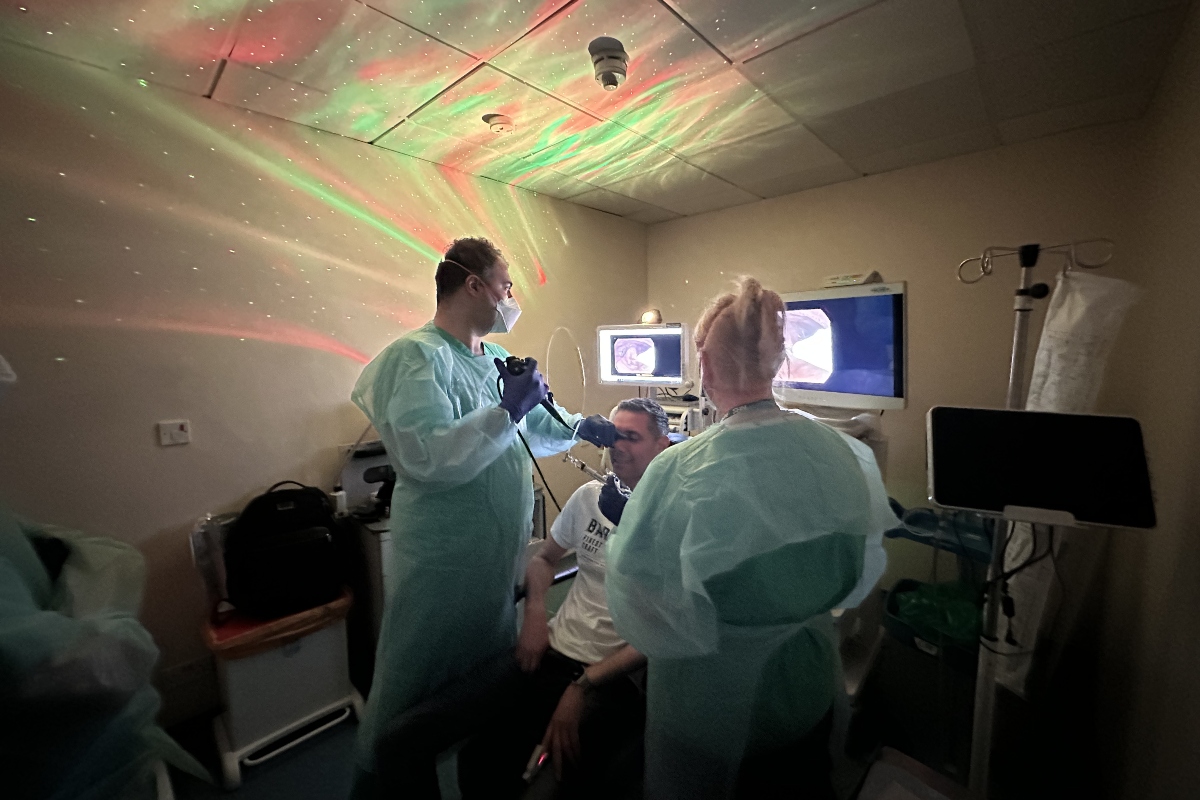
Perioperative mindfulness delivered by a specialist team is associated with high satisfaction in awake endoscopy and could expand access to aerodigestive diagnostics beyond sedation and theatre settings, according to a recent study.
Published in the British Journal of Nursing, this service evaluation described the development of a mindful endoscopy team to support awake examination of the ‘path of swallowing’.
Conventional awake aerodigestive procedures can provoke anxiety and discomfort, while sedation or general anaesthesia requires additional resources and may limit access to timely outpatient investigation.
The mindful endoscopy approach therefore used a structured, team-based model that incorporated breathing techniques, relaxation, communication strategies, positive imagery such as aura-light projections, music and continuous support from trained practitioners.
The authors evaluated 241 patients undergoing mindful endoscopy between July 2022 and July 2023. Patients were randomly selected for analysis, and the indications included swallowing, throat and voice symptoms requiring diagnostic assessment of the upper aerodigestive tract.
Procedures comprised 180 oral and pharyngolaryngeal (OPL) endoscopies and 70 transnasal panendoscopies (TNP).
Of these, 171 patients underwent OPL endoscopies, 61 had TNP endoscopies and nine had both procedures. The cohort had a mean age of 59±15 years and included 96 men and 145 women.
Mindful endoscopy, satisfaction and cancer detection
Patient experience was assessed using the Gastrointestinal Endoscopy Satisfaction Questionnaire. Overall satisfaction was ‘overwhelmingly positive’, the authors said, with 92.4% of patients reporting being satisfied or very satisfied.
In addition, 94% rated the technical quality of the procedure as good or very good, and 96.4% stated they would be happy or very happy to undergo the same procedure again with the same team.
These findings were presented alongside previously reported satisfaction rates using the same measure for conventional awake aerodigestive endoscopy (53.3%) and sedated endoscopy (86.2%), highlighting a favourable result for mindful awake endoscopy.
The evaluation identified 12 cancers (5.0%) among the 241 patients. Diagnoses included glottic, supraglottic and hypopharyngeal cancers, as well as tonsillar, oesophageal, thyroid and secondary intrathoracic malignancies.
At a mean follow-up of 14±4 months (range 7–25 months), no additional post-investigation cancers were reported.
Benefits for staff and patients
Commenting on the findings, lead author Professor Reza Nouraei, professor of laryngology and clinical informatics at the University of Southampton and consultant ear, nose and throat surgeon at the Loxley Centre for Airway, Voice and Swallowing at Queen’s Medical Centre, Nottingham, said, ‘This one-stop approach means that most problems can be diagnosed with one appointment.
‘For the small number of patients with cancer or other major problems, biopsies can often be taken there and then, and the road to treatment and recovery can begin straight away.
‘Using mindfulness to support patients through these examinations is a large part of what makes them possible.’
While the results indicate that structured perioperative mindfulness may support the delivery of awake aerodigestive endoscopy, with high patient acceptability and maintained diagnostic yield, the findings are preliminary.
Study limitations included the evaluation design and the need to establish generalisability and safety across different clinical settings and procedures, the authors said.
They concluded: ‘By integrating mindfulness strategies into endoscopic procedures, this study suggests potential benefits beyond aerodigestive diagnostics, with a scalable approach to other invasive procedures in outpatient and community diagnostic settings.’
Future research directions identified by the authors included assessing the impact of perioperative mindfulness on staff wellbeing and developing standardised training, competency frameworks and accreditation processes for mindful endoscopy teams.
Reference
Bond J et al. Mindful endoscopy: holistically supporting patients through awake examinations of the path of swallowing. Br J Nurs 2026;35(1):16–24.