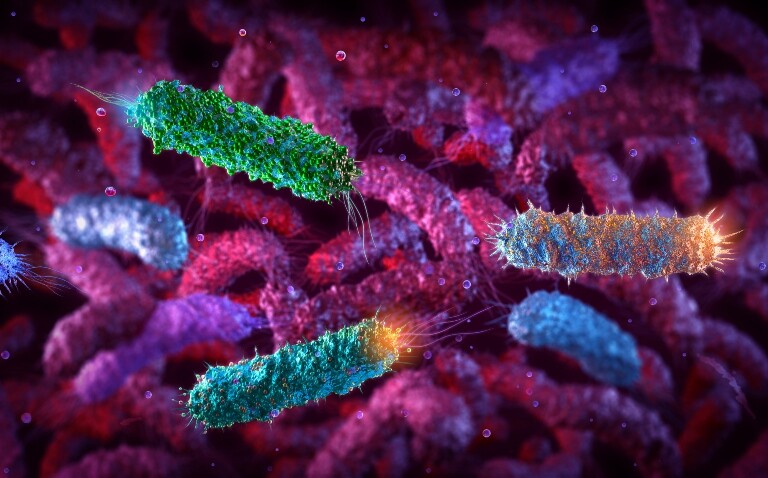
New modelling and single-cell analyses reveal how bacterial RNA repair shapes variable responses to ribosome-targeting antibiotics.
Researchers have identified a previously unrecognised mechanism driving transient antibiotic resistance in Escherichia coli (E. coli), showing that heterogeneity in the expression of RNA-repair proteins enables subsets of cells to withstand ribosome-targeting antibiotics.
The findings, published in the journal Nature Communications, combine computational modelling with single-cell analyses to examine how the Rtc system – comprising the RNA cyclase RtcA, RNA ligase RtcB and transcriptional regulator RtcR – helps maintain the translation apparatus during antibiotic stress.
The study used non-pathogenic laboratory E. coli K-12 strains, including wild-type cells and rtc gene-deletion mutants. The authors created a mathematical model of Rtc-regulated RNA repair that included transcription and translation of rtc genes, ATP-dependent activation of RtcR, and the repair and sealing of damaged rRNA or tRNA.
Experimental validation included single-molecule RNA-fluorescence in situ hybridisation (RNA-FISH) to quantify rtcB transcripts in hundreds of individual cells, in vivo translation-elongation assays, and single-cell microspectroscopy to evaluate ribosome content following tetracycline exposure.
Antibiotic bistability and heteroresistance
The computational model showed that the Rtc system exhibits bistability, meaning that cells can adopt either a resistant ‘Rtc-on’ or a susceptible ‘Rtc-off’ state under the same level of antibiotic-induced damage.
This bistability promotes cell-to-cell heterogeneity and indicates that rtc expression supports a form of heteroresistance – a transient and reversible resistance phenotype within genetically identical populations.
Single-cell RNA-FISH confirmed significant heterogeneity in rtcB expression: although the average expression increased by around 2.5-fold after tetracycline treatment, this rise was due to only a small proportion of expressing cells.
Translation-elongation assays further demonstrated that cells lacking rtcB had slower translation even without antibiotic exposure and were more severely affected under tetracycline challenge, suggesting that RtcB helps maintain translational capacity during stress.
The model also predicted that inhibiting RtcB or RtcR would substantially reduce the range of damage conditions that permit Rtc-mediated resistance, whereas inhibition of RtcA would have only minor effects.
The model relies on simplifying assumptions and while experimental data confirm heterogeneity in rtcB expression, they do not directly demonstrate bistability as the cause, as hysteresis was not measured.
The study also does not evaluate potential redundancy from multiple RtcB homologues in some strains or assess the feasibility of Rtc-targeting inhibitors in vivo.
RNA repair: future research and clinical implications
The researchers highlighted RtcB and RtcR as promising inhibitory targets to enhance the effectiveness of ribosome-targeting antibiotics by preventing Rtc-mediated translational rescue. They noted, however, that RtcR may be susceptible to resistance mutations, and that RtcB is conserved across host organisms, presenting challenges for selective inhibition.
The study positions RNA repair as an underexplored contributor to antimicrobial resistance and demonstrates how modelling-guided biology can identify new intervention points in bacterial survival mechanisms.
Dr Andrea Weisse of the University of Edinburgh’s Schools of Biological Sciences and Informatics, who led the study, concluded: ‘Bacteria are clever little things. They have been learning how to dodge our antibiotics, and they are getting better at it all the time. If we don’t find new drugs – or new tricks to outsmart them – we are in trouble.
‘What we are trying to do here is really understand how their defence systems work. Once we see the mechanism clearly, we can figure out smarter ways to beat them and treat infections more effectively.’
Reference
Hindley H et al. Heterogeneity in responses to ribosome-targeting antibiotics mediated by bacterial RNA repair. Nat Commun 2025;16:9620.