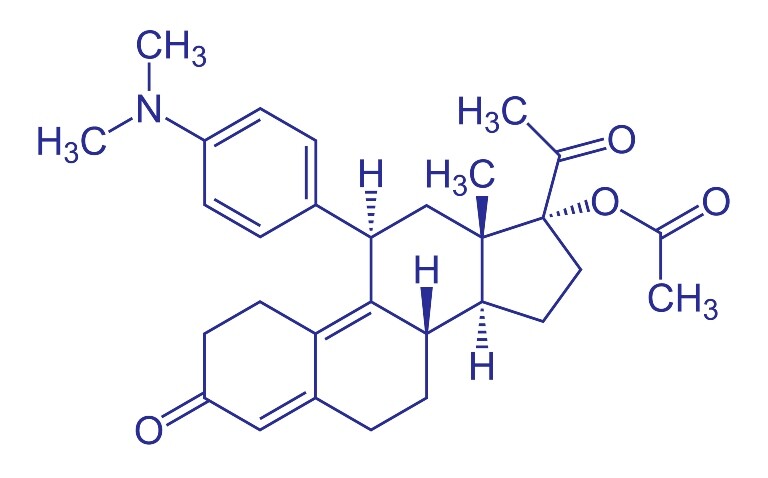
Progesterone receptor antagonism with ulipristal acetate has the potential to prevent aggressive breast cancer in high-risk premenopausal women, a UK study finds.
Breast cancer is the leading cause of cancer-related death in women globally, and the most common cause of death of women in the UK, researchers led by experts at the University of Manchester wrote in the journal Nature.
Previous research had pointed to basal triple-negative breast cancer originating in luminal progenitor cells, with suggestions that that progesterone inhibition could suppress luminal progenitor cell activity.
In this study the researchers used paired vacuum-assisted breast biopsy (VAB) tissues, before and after treatment, alongside blood tests and MRI scans, to assess whether 12 weeks of ulipristal acetate therapy reduced surrogate markers of breast cancer risk in 24 premenopausal women with a history of breast cancer.
After observing changes in the breast tissue, they concluded that progesterone contributed to breast cancer development through paracrine effects on the luminal progenitor/luminal adaptive secretory precursor (LASP) cell fraction.
In particular, they found that ulipristal acetate reduced fibroglandular volume and epithelial cell density, which lowered the proportion, proliferation and activity of the luminal progenitor/LASP population.
The researchers suggested that progesterone receptor antagonism worked to remodel the extracellular matrix (ECM), reducing collagen organisation and tissue stiffness.
This finding highlighted the importance of stromal–epithelial interactions in both luminal progenitor/LASP cell maintenance and breast density, they wrote.
Among the ECM-related proteins, collagen VI was found to be one of the most downregulated, linking epithelial cells with the ECM.
Of note, they found premenopausal women with dense breasts at baseline were more likely to respond to progesterone receptor antagonism.
‘Our therapeutic cancer prevention trial in premenopausal women demonstrates the potential for [progesterone receptor] antagonism to reduce mammographic density, tissue stiffness and luminal progenitor activity, which are important hallmarks of breast cancer risk,’ they concluded.
A powerful breast cancer prevention tool
Clinical lead author Dr Sacha Howell, clinical senior lecturer at The University of Manchester, director of the Manchester Breast Centre and consultant oncologist at The Christie NHS Foundation Trust, said the research provided evidence that progesterone played a critical role in breast cancer development in high-risk individuals.
‘What makes this study particularly exciting is the combination of clinical imaging and biological analysis, which gives us a powerful tool to understand how prevention therapies work at both the tissue and molecular levels,’ he said.
‘These results lay important groundwork for larger trials to confirm the potential of anti-progestins in reducing breast cancer risk.’
Laboratory lead author Dr Bruno Simões, research fellow at The University of Manchester and principal investigator at the Manchester Breast Centre said the team was intrigued by how anti-progestins reshaped the breast tissue environment at the molecular level, reducing the number of tumour-initiating cells.
‘We observed clear reductions in collagen levels and organisation, giving us direct insight into how targeting progesterone signalling can create conditions that make it harder for cancers to develop,’ he said.
The research was particularly exciting because it suggested that women with increased breast density – a well-established risk factor for breast cancer – might benefit most from preventive treatment with an anti-progestin drug, Dr Simões noted.
Ulipristal acetate offers ‘an important step forward’
The study was funded and supported by the charities Breast Cancer Now and Prevent Breast Cancer, respectively.
Dr Simon Vincent PhD, Breast Cancer Now’s chief scientific officer, said women at high-risk of breast cancer can only choose surgery or long-term hormone therapy to reduce their risk at present.
‘This research into ulipristal acetate is an important step forward and aligns with our key strategic goal to accelerate the discovery of preventative treatments,’ he said.
‘We now need larger, longer-term studies, so we can fully understand the potential of this drug to stop breast cancer developing.’