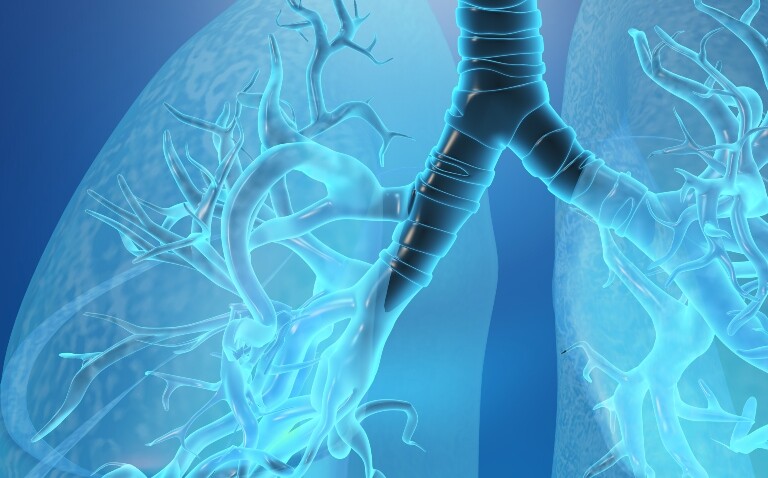
Robotic-assisted bronchoscopy combined with a specialist CT scanner can reach very small tumours growing in hard-to-reach parts of the lung, offering patients the possibility of earlier lung cancer diagnosis, new research has shown.
The results of the gold-standard randomised controlled trial were exclusively presented at the European Society Congress.
‘This technology is very advanced but also very expensive, so it is important to test whether it performs better than traditional bronchoscopy,’ explained lead author Dr Thomas Gaisl from University Hospital Zürich, Switzerland. ‘To date, there has been no direct evidence that the cost of the system translates into better clinical outcomes.’
Benefits of robotic-assisted bronchoscopy with CBCT
Dr Gaisl and his research team conducted a clinical trial of 78 patients. Between them, they had a total of 127 abnormal growths at the outer edges of the lungs, where there is often no access via a connecting airway. To further add to the complexity, the tumours were only 11mm wide on average, and less than 15% had a connecting airway.
Half of the patients were randomly assigned to be tested with the new robotic-assisted bronchoscopy combined with integrated cone-beam CT (CBCT) to take a biopsy and confirm or rule out the presence of cancer. The remaining half were tested with standard technology – a very thin bronchoscope that uses X-ray imaging for guidance.
When the traditional technique was used, doctors were able to reach and take a biopsy for 23% of the tumours. In contrast, when the robot-assisted technology was used, more than 84% of the tumours could be reached and biopsied.
In cases where a biopsy was not able to be taken with the traditional technique, patients were then tested with the robot-assisted technology. Of these, almost 93% were successfully taken.
In total, 68 patients were diagnosed with lung cancer, and 50 had stage 1A disease.
Dr Carolin Steinack, a researcher and senior physician from Dr Gaisl’s team, commented: ‘Robotic-assisted bronchoscopy with CBCT achieved a diagnostic yield more than three times higher than conventional bronchoscopy. In clinical practice, this technology enables accurate diagnosis in patients for whom conventional bronchoscopy offers no viable option.’
Justifying investment in new technology
Dr Steinack noted that around 20 robotic-assisted bronchoscopy with CBCT systems are used in Europe at present, although this is increasing.
‘The technology allows specialists to access nearly any region of the lung, meaning that we can offer biopsy to more patients, and diagnose cancers earlier when treatment is more likely to be effective,’ she said.
The cost of the new system is around €1m, which adds around €2,000 to the cost of a single procedure. But Dr Gaisl is positive about its cost-effectiveness.
‘In centres that see lots of patients with these tumours, I believe the benefits of this technology justify the investment,’ he said. ‘However, the robotic system should be reserved for small, hard-to-reach lesions, where conventional bronchoscopy is not an option.’
The researchers will now investigate whether the same technology could be used to combine diagnosis and treatment of lung tumour into one procedure by locating a tumour and delivering radio waves or microwaves that can destroy cancerous tissue.
In December 2025, a clinical study at Royal Brompton and St Bartholomew’s hospitals in London showed that shape-sensing robotic-assisted bronchoscopy could help patients with suspected lung cancer to receive an early diagnosis, potentially leading to faster intervention and better outcomes.