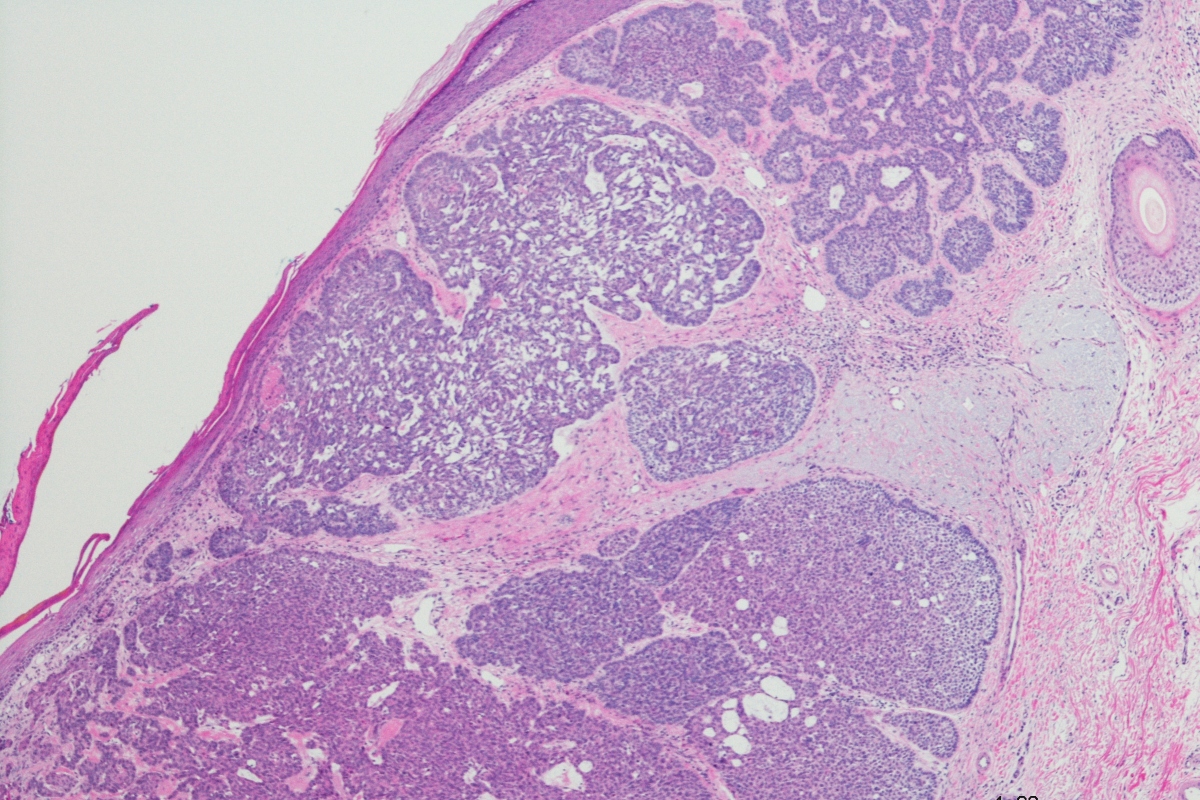
Ex vivo confocal laser scanning microscopy (EVCM) could provide rapid and accurate diagnosis of basal cell carcinoma (BCC) in tissue specimens, according to a recent study, although its performance for surgical margin assessment remains insufficient to replace conventional histology as a standalone approach.
Researchers from University Hospital, Ludwig Maximilian University (LMU), Munich, Germany, aimed to evaluate the diagnostic accuracy of the newer microscope technique EVCM for BCC diagnosis and margin assessment during micrographic surgery. Conventional histopathological examination served as the reference standard.
Published in the journal Acta Dermato-Venereologica, the researchers systematically searched MEDLINE and Embase in November 2024 and identified 16 eligible studies involving 1,387 specimens – the majority of which originated from the head and neck region (91.8%).
Nodular BCC was the most common histological subtype (45.3%), followed by sclerodermiform or micronodular BCC (30.1%) and superficial BCC (10.8%). The pooled mean patient age was 73.2 years and 41.6% of participants were female.
Diagnostic performance of EVCM for BCC detection
Seven studies assessed the diagnostic performance of EVCM for BCC detection in punch, shave or bread-loaf excision specimens. The pooled sensitivity was 91.4% (95% CI 85.9–94.9) and pooled specificity was 91.1% (95% CI 79.2–94.5), with low between-study heterogeneity (I²=5.2%). The authors noted that EVCM correctly identified the presence or absence of BCC in approximately nine out of 10 tissue specimens.
A further 12 studies evaluated EVCM for margin assessment during micrographic surgery. In this setting, pooled sensitivity was 79.5% (95% CI 65.0–89.0) and pooled specificity was 92.2% (95% CI 85.5–95.9), with moderate heterogeneity (I²=13.8%).
EVCM correctly identified tumour-free margins in approximately nine out of 10 cases but detected margin involvement in only around eight out of 10 cases. As a result, tumour extension at the surgical margin could be missed in around two out of 10 cases, the authors said.
Subgroup analyses found no statistically significant differences in diagnostic accuracy between Mohs surgery, the margin-strip technique – often known as Tübinger Torte – and the muffin technique. However, newer-generation EVCM devices demonstrated significantly higher sensitivity for BCC diagnosis than older-generation systems (93.9% vs 83.0%; P=0.002), while specificity remained similar. No significant device-related differences were observed for margin assessment.
Limitations and future potential
The authors highlighted several study limitations, including the fact that the literature search was restricted to two databases and subgroup analyses were based on relatively few studies and were associated with wide confidence intervals.
Most included studies were single-centre investigations conducted under experimental or semi-controlled conditions, potentially limiting generalisability to routine practice. Several studies also originated from LMU University Hospital – the authors’ institution – introducing a potential source of institutional clustering bias.
Clinically, the findings suggested that EVCM may selectively replace conventional histology when rapid diagnosis of BCC is required to facilitate prompt treatment. However, for intraoperative margin assessment, conventional histology should still be performed as a subsequent step, particularly following the final stage of stepwise micrographic surgery.
Future research should focus on improving margin assessment accuracy and evaluating integrated workflows combining in vivo and ex vivo confocal imaging, the authors said, as well as exploring the role of artificial intelligence in image interpretation and diagnostic support.
Reference
Lukacs S et al. The Diagnostic Accuracy of Ex Vivo Confocal Laser Scanning Microscopy for Basal Cell Carcinoma: A Systematic Review and Meta-analysis. Acta Derm Venereol 2026 Jun 15;106:0393.