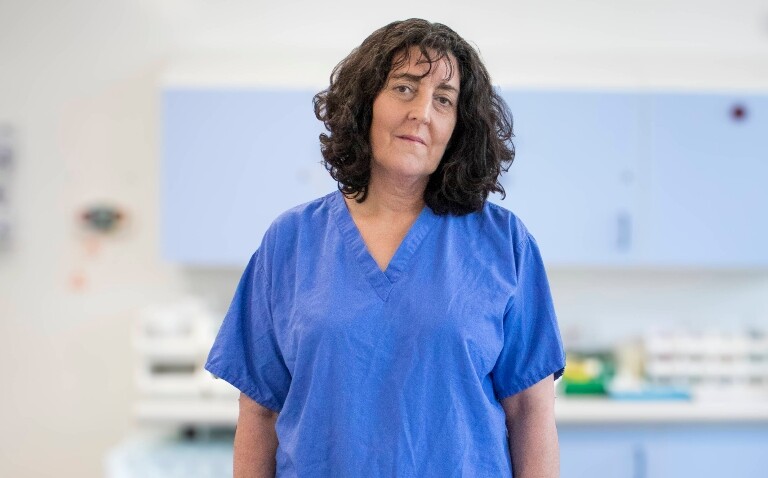
As an exhibition entitled ‘Insight: Portraits of Women in Surgery’ continues in London, Professor Felicity Meyer speaks to Saša Janković about her reflections on the evolving role of women in the profession, the barriers that remain and why visibility and mentorship are key to driving lasting change.
As of March 2025, there were more women doctors in the UK than men for the first time in history. Yet this progress sits alongside persistent inequalities, with just 40% of those in surgical training and 16.9% of consultant surgeons being women, according to the Royal College of Surgeons of England (RSC England).
In fact, for every female consultant surgeon, there are currently an average of five male consultants. And while no surgical specialty has more than 29% female consultants, this figure is below 9% in specialties such as trauma and orthopaedics.
It is within this disparity that the new ‘Insight: Portraits of Women in Surgery’ exhibition offers a timely and human explortion of what it means to be a woman working in surgery today.
Running at RCS England’s Hunterian Museum until 18 April 2026, the exhibition brings together portraits of women surgeons from across the UK, spanning different specialities, career stages and regions.
Shared aims for women in surgery
Central to both the exhibition and the wider conversation around women in surgery is Professor Felicity Meyer, a consultant vascular surgeon at The Queen Elizabeth Hospital King’s Lynn NHS Foundation Trust.
Alongside her clinical practice, which spans arterial, venous and access surgery, Professor Meyer holds national roles with the RCS England, including previously as flexible working advisor, and has long been involved in shaping policy and workforce discussions.
Her leadership within RCS England’s Women in Surgery (WinS) Forum, where she is the first elected chair, also reflects a sustained commitment to improving access to and experience of surgical careers for women.
That work sits within the broader remit of the WinS network – a national initiative bringing together more than 6,000 members, from medical students to senior consultants, united by a shared aim of advancing surgical careers for women.
Raising awareness among public and peers
Professor Meyer traces the origins of the RCS England photographic exhibition back to a striking absence she noticed herself.
‘Going around the Hunterian Museum, it’s clear that, until recent times, the history of women in surgery hasn’t been featured much, other than as patients,’ she recalls, ‘which then sparked conversations about how women’s contributions to the profession today could be more visibly represented in order to raise awareness of the speciality among women.’
What followed was a collaborative effort shaped through the WinS network. ‘We put out a call inviting members to have their photo taken for a portrait,’ Professor Meyer explains. ‘But the real genius of it was that the Hunterian Museum got the pictures taken by either their comms team or the illustration department of the hospitals the surgeons worked in, which meant we got a whole set of different photographs taken by people who’ve interpreted the brief a bit differently. This also meant participants could have their picture taken at a time that suited them, in a place they were familiar with.’
This approach created a ripple effect well beyond the walls of RCS England. ‘It means that those hospitals feel they’ve got ownership, with the added bonus that their local communications teams then shared the portraits locally and widely, so we’re getting to reach the people we really want to reach,’ says Professor Meyer.
At its core, the exhibition is about challenging perceptions and opening up possibilities to inspire young women and girls to go into surgery, while also correcting misconceptions shaped by news and media portrayals.
These, Professor Meyer says, ‘mostly never show us as we really are’ and so the exhibition presents ‘a diverse range of surgeons at different stages of their careers to make the profession feel more accessible and show all women that they could be a surgeon’.
Evolution and progress for women in surgery
Professor Meyer admits that while progress has been made when it comes to the evolution of a career path for women in surgery, it has been neither straightforward nor sufficient.
‘There are a lot more female consultants, so something must have gone right,’ she says, pointing to the steady increase since the early 2000s, when women made up only a small fraction of the consultant workforce.
But she is equally clear that the gains seen so far have required active intervention rather than passive change. ‘People always thought that as you had more women coming through medical school, we’d get more female surgeons, but it hasn’t worked like that, so we know it needs a more active approach,’ Professor Meyer says.
Part of the challenge, she believes, lies in how surgery continues to be perceived, both within and outside the profession. ‘When you look in the media, the way surgeons are portrayed is a little bit off and I don’t think that helps the image of surgery,’ she says, adding that portrayals of female surgeons in particular fail to reflect reality. ‘We’re just ordinary, and I don’t think that’s represented very well.’
More concerning, however, are the cultural and structural issues that have historically shaped the profession. ‘A recent British Medical Association survey showed there’s a big issue around sexual misconduct in surgery – some of which was very serious – and that is, of course, something that shouldn’t be happening,’ says Professor Meyer.
And while she believes progress is being made through initiatives such as NHS England’s Sexual Safety Charter and strengthened codes of conduct, she is clear that ‘we’re not there yet’.
Alongside this, Professor Meyer highlights a more ingrained cultural barrier, which she calls the ‘boys’ club issue’.
‘Informal networks and the “tap on the shoulder” can still shape access to opportunities, particularly in areas such as accessing training, and in private practice,’ she explains.
And while tangible improvements such as flexible working and training have become much more accepted as part of practice for both men and women in recent years, Professor Meyer notes that structural barriers remain.
‘For example, if you’re doing less than full time, you still fill a full time slot, so we need better workforce planning and funding to support this shift,’ she says.
‘Surgery is my happy place’
Nonetheless, Professor Meyer says a career in surgery is ‘very fulfilling’, adding: ‘If I had my time again, would I do it? Absolutely. For me, surgery is my happy place.’
Yet she is equally candid about the barriers that remain. ‘There are lots of challenges for all surgery trainees,’ she notes, ‘but women can face additional hurdles, from unequal access to training opportunities, to male-oriented cultural norms within the profession’.
Indeed, women are more likely to leave before the completion of surgical training, and one of the most significant factors in navigating challenges, is support.
‘We know from research that what makes women stay in surgery is having a good mentor, and networks such as WinS play a crucial role here, particularly for those who may find themselves isolated within their specialty or region,’ Professor Meyer explains. ‘If you’re running into difficulty, you’ve got someone you can go to, and that makes a huge difference.’
Professor Meyer’s advice to those considering the profession is that: ‘If anyone wants to become a surgeon, they should definitely do it. In the end, the patients are the best thing about being a surgeon. It’s a real privilege that people trust us with their very being and I learn something new from them every day.’