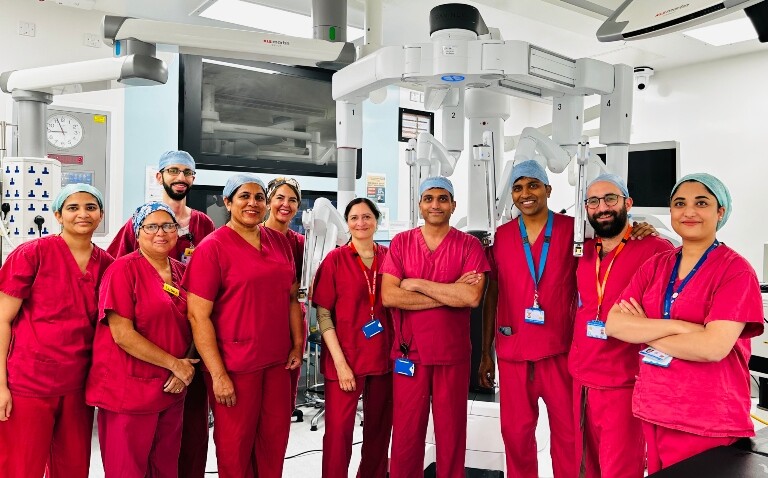
Mr Vanash Patel, consultant colorectal surgeon at West Hertfordshire Teaching Hospitals NHS Trust, discusses his recent research exploring real-world outcomes, learning curves and operational strategies in robotic surgery, and how structured training, multidisciplinary collaboration and careful case selection enable high-quality, efficient care – even for complex patients.
Robotic-assisted surgery is now an established part of colorectal cancer care in the UK, having seen significant expansion over the past decade. Robotic systems are increasingly being adopted by district general hospitals, reflecting the growth of services already embedded in teaching centres.
Our team recently undertook research to demonstrate that our own district general hospital could safely transition to a high-volume robotic programme. It also focused on generating robust, real-world data on learning curves and service performance to inform investment, training and wider NHS adoption.
Study design
This prospective cohort study evaluated the first 102 consecutive elective colorectal cancer resections performed using the da Vinci Xi robotic system between April 2024 and May 2025.
Four colorectal consultants operated, three of whom had prior experience with the surgical robotic systems. We collected detailed demographic, comorbidity, operative and histopathology data and benchmarked outcomes against national laparoscopic data from the National Bowel Cancer Audit and the Model Health System.
Key endpoints included conversion to open surgery, anastomotic leak, return to theatre, length of stay and oncological quality indicators such as lymph node yield and margin status.
Learning curves were explored using cumulative sum (CUSUM) analysis for right hemicolectomy, anterior resection and abdominoperineal resection.
Key operational considerations
Operationally, the robot cannot be introduced as a ‘bolt-on’ technology; it has to be embedded into existing pathways. For us, success depended on careful list construction, clear standard operating procedures and close collaboration with theatre management.
Early on, we protected longer lists for robotic cases, avoided excessive case mixing, and focused on predictable right-sided resections as the team gained confidence in docking and workflows.
Supporting surgeons with varying levels of experience required a tiered approach. All consultants completed the robotic training pathway, including simulation and proctored cases. Those with previous robotic surgery experience led the initial adoption, taking on the most complex pelvic work while mentoring colleagues. As learning curves flattened, we progressively involved senior trainees at the console under direct supervision.
Theatre efficiency gains came from repetition, standardised port maps and having a consistent core team of scrub, circulating and anaesthetic staff. Regular governance reviews of operative times, conversion and complications helped us to identify where additional support or retraining was needed.
Impact of previous robotic surgery experience
We used CUSUM analysis of operative times to understand both service-level and individual learning curves. At the unit level, right-sided resections stabilised after about 12 cases, and low pelvic resections after about 20 cases. However, there was clear inter-surgeon variability.
The surgeons who had previously completed a substantial robotic surgery caseload reached time-neutral performance in fewer cases and ultimately generated net time savings, while those without prior robotic exposure remained in an early learning phase.
Several factors appear crucial:
- Prior console experience is clearly important, as many psychomotor skills are transferable between platforms
- A structured training pathway, including simulation, dry-lab work and proctored cases, accelerates safe progression
- Case selection also matters, beginning with straightforward right hemicolectomies and progressing to irradiated, obese or low-rectal cases once the basic workflow is established
- Team familiarity in theatre, including port placement, docking, anaesthetic and nursing routines, reduces friction for the surgeon and shortens the learning curve beyond individual technical skill alone.
A sustainable robotic surgery training programme
The sustainability of a robotic surgery training programme rests on three pillars: structured curricula, protected access to cases, and a genuinely multi-professional approach.
For consultants, there must be a clear pathway from simulation and dry-lab training through to proctored cases, independent operating and then training others. This should align with credentialing frameworks and be underpinned by objective data on outcomes and learning curves.
For trainees, robotic exposure cannot be left to chance. They need graduated responsibility at the console – starting with set-pieces such as vessel ligation or medial-to-lateral dissection – and clear case numbers and competencies defined within their training programmes. Video review, simulation and dual-console operating are invaluable for feedback and skill acquisition.
Equally important is investing in theatre nurses, operating department practitioners and anaesthetists so that robotic lists are viewed as a shared endeavour, not a niche interest.
Finally, integrating robotic surgery into job plans and service design is essential to avoid burnout and ensure sufficient volume for both high-quality care and meaningful training.
Changing the approach to managing challenging cases
Our overall conversion rate was 3%, and notably none of the patients with a body mass index (BMI) over 35 required conversion or return to theatre.
The enhanced visualisation and wristed instrumentation make working in deep, narrow pelvises or thick mesentery more controlled, which has expanded our confidence in offering minimally invasive surgery to patients who might previously have been considered borderline for laparoscopy.
That said, we have not abandoned careful case selection. In the earliest phase, we prioritised simple cases to establish workflows. As the programme advanced and learning curves stabilised, we deliberately included higher-BMI, irradiated and low rectal cancers, while maintaining close multidisciplinary team (MDT) oversight.
The robot also changes intra-operative decision-making. Improved ergonomics and instrument control may reduce the threshold at which a surgeon feels compelled to convert because of fatigue or poor access.
However, we emphasise that conversion remains a legitimate safety decision. The goal is not zero conversions, but to avoid preventable conversions through better technology and preparation.
The importance of collaboration on outcomes
Multidisciplinary collaboration is absolutely central to the results we report. At one level, this is about traditional MDT working: colorectal surgeons, radiologists, oncologists and specialist nurses agreeing optimal oncological strategies and selecting patients appropriately for minimally invasive surgery.
Equally important is the operational MDT. Theatres, anaesthetics, ward teams, virtual hospital nurses and managers all played a role in enabling early mobilisation, optimised analgesia and safe early discharge.
Around a quarter of our patients were discharged via a remote-monitoring pathway, which almost certainly contributed to the reductions in length of stay compared with national data.
Industry partners also formed part of the wider team, providing initial training, technical support and troubleshooting during the transition phase. Regular governance meetings reviewing outcomes, learning curves and patient feedback created a feedback loop that allowed us to refine protocols.
In short, the robot was one enabler, but the culture of collaboration across disciplines is what turned a new technology into a high-performing service.
What’s next for robotic surgery in colorectal cancer?
Our experience suggests that robotic colorectal surgery is moving from a niche innovation to a core component of cancer pathways, even in district general hospitals.
Technologically, we will see greater platform competition, more compact systems and the progressive integration of artificial intelligence for image guidance, performance analytics and potentially semi-autonomous tasks.
Service design will need to keep pace. Robotic surgery works best when embedded in enhanced recovery and virtual ward pathways that leverage its minimally invasive nature to safely shorten hospital stays. I anticipate wider use of remote monitoring, digital prehabilitation and patient-facing apps integrated around robotic episodes of care.
Training will increasingly be data-driven, using simulator metrics, video review and learning-curve analysis to personalise progression for both consultants and trainees. Strategically, I expect networks of robotic centres to collaborate and share curricula, outcome data and capacity.
Ultimately, the focus will shift from asking whether robotics is ‘better than’ laparoscopy to how we use it intelligently to deliver safer, more efficient and more person-centred colorectal cancer care.
Achieving high-quality surgical care
Overall, adopting the robotic platform has allowed us to deliver consistently high-quality resections with very low morbidity. In our cohort, all colonic resections achieved a lymph node yield of at least 12, and almost all rectal resections had negative margins, which compares favourably with national laparoscopic benchmarks.
Conversion to open surgery was only 3%, and the anastomotic leak rate was 1%, despite a comorbid, older population.
Practically, three-dimensional vision, wristed instruments and stable ergonomics make complex pelvic and high-BMI cases more controlled and less fatiguing. This translates into more reproducible dissection planes and reliable total mesorectal excision.
At system level, we saw a reduction in prolonged length of stay compared with national data, with many patients discharged earlier, often supported by our virtual hospital pathway.
Overall, adopting a robotic platform has improved the consistency of oncological quality, reduced unplanned deviations such as conversion, and created a better training environment at the console, which is difficult to replicate with conventional laparoscopy.
Author
Vanash Patel MB BS MSc PhD DIC FRCS (Gen Surg)
Consultant colorectal surgeon and colorectal lead, West Hertfordshire Teaching Hospitals NHS Trust, UK