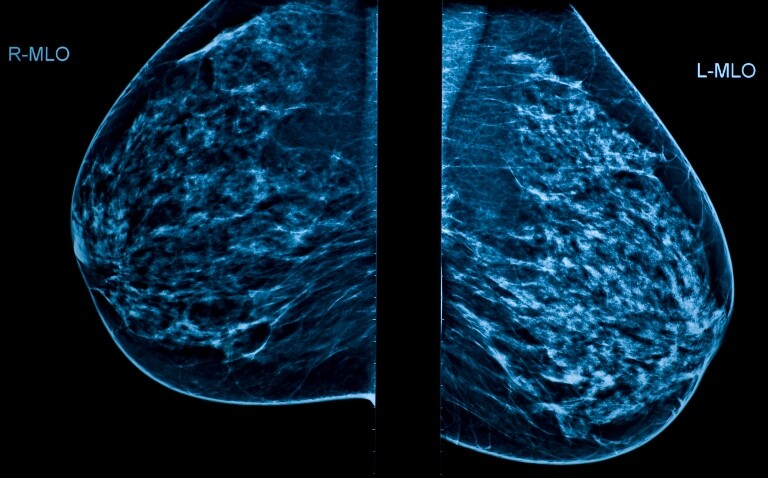
The use of artificial intelligence (AI) in mammography screening is associated with higher sensitivity and fewer unfavourable interval cancers without compromising specificity, according to the results of a large population trial.
The Mammography Screening with Artificial Intelligence (MASAI) study evaluated whether AI-supported mammography screening was non-inferior to the standard practice of double readings by two breast radiologists in terms of interval cancer rate – a key indicator of screening performance.
Interval cancers were defined as primary breast cancers diagnosed between screening rounds or within two years after a negative screening assessment.
Between April 2021 and December 2022, 105,934 women attending routine population-based screening in southwest Sweden were randomly assigned in a 1:1 ratio to AI-supported screening or standard double reading.
After exclusions, 53,043 women were analysed in the intervention group and 52,872 in the control group. Participants were aged 40–80 years, with a median age of 53.8 years in the AI group and 53.7 years in the control group. Most women attended routine screening, with small proportions undergoing surveillance due to prior breast cancer or moderate hereditary risk.
AI-supported mammography screening
After at least two years of follow-up, interval cancer rates were 1.55 per 1,000 screened women in the AI-supported group and 1.76 per 1,000 in the control group. This met the prespecified criterion for non-inferiority, with a proportion ratio of 0.88. Sensitivity was significantly higher with AI-supported screening (80.5%) compared with standard double reading (73.8%), while specificity was identical in both groups at 98.5%.
There were 16% fewer invasive cancers, 19% fewer large cancers (T2+) and 27% fewer aggressive non-luminal A molecular subtypes. Sensitivity gains were consistent across age and breast density subgroups and were evident for invasive cancers, but not for in-situ disease.
A lack of generalisability was noted by the authors as the study was conducted within a single national screening programme, with only one mammography vendor and one AI system, as well as relying on a single screening round. Radiologists were not masked to allocation, and findings may not generalise to settings with different workflows or lower baseline performance, they added.
The MASAI trial had already shown that AI support in mammography screening contributed to a 29% increase in detected breast cancers compared to traditional screening, detecting mostly small, lymph node negative invasive cancers.
The authors have now concluded that AI-supported mammography screening could improve screening performance while maintaining safety, supporting consideration for broader clinical implementation.
‘Simple and effective’
Lead author Dr Kristina Lång, researcher and associate professor of diagnostic radiology at Lund University and consultant in radiology at the Unilabs Mammography Unit in Malmö, Sweden, said: ‘Widely rolling out AI-supported mammography in breast cancer screening programmes could help reduce workload pressures amongst radiologists, as well as helping to detect more cancers at an early stage, including those with aggressive subtypes.
‘However, introducing AI in healthcare must be done cautiously, using tested AI tools and with continuous monitoring in place to ensure we have good data on how AI influences different regional and national screening programmes and how that might vary over time.’
She added: ‘As the method is simple and effective and we can now demonstrate good results, it will probably have a general international impact in countries that use mammography screening.’
Future research is now planned to assess outcomes over subsequent screening rounds and to evaluate cost-effectiveness.
Reference
Gommers J et al. Interval cancer, sensitivity, and specificity comparing AI-supported mammography screening with standard double reading without AI in the MASAI study: a randomised, controlled, non-inferiority, single-blinded, population-based, screening-accuracy trial. Lancet 2026;407(10527):505–14.