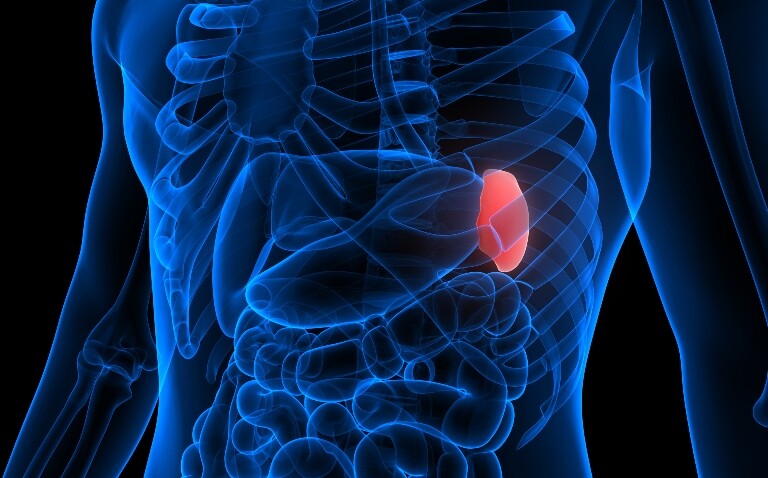
Incidentally detecting splenomegaly during routine imaging is associated with a substantially increased risk of underlying haematological cancer and liver disease once specific spleen size thresholds are exceeded, a large population-based cohort study has shown.
The study, published in JAMA Oncology and led by teams from the University of Copenhagen and Copenhagen University Hospital, quantified both relative and absolute risks of haematological cancers, liver cirrhosis and liver cancer according to spleen length and spleen volume in individuals with splenomegaly detected incidentally on computed tomography or magnetic resonance imaging.
Using two independent general population cohorts, a total of 47,066 individuals were included: 8,459 from the Danish Copenhagen General Population Study and 38,607 from the UK Biobank.
Median age at imaging was 61 years in Denmark and 65 years in the UK, with women comprising 57.0% and 51.9% of participants, respectively.
Spleen length was measured in Danish participants, whereas spleen volume was assessed in both cohorts. All participants were free of known haematological disease at baseline and were followed prospectively for a median of five years after imaging.
Splenomegaly linked to increased disease risk
The researchers found that risk of haematological cancer increased markedly with increasing spleen size. Relative risk was highest among individuals with a spleen length or volume above the 99th percentile. Compared with those in the mid-range (26th–74th percentiles), Danish participants with a spleen length greater than 134 mm had a more than five-fold higher risk of any haematological cancer (hazard ratio (HR) 5.11; 95% CI 2.00–13.06).
Risk was even more pronounced for spleen volume, with HRs of 11.08 (95% CI 5.44–22.59) in Denmark and 11.82 (95% CI 6.98–20.02) in the UK for volumes above the 99th percentile.
Clinically applicable cut-offs revealed important gradients in absolute risk. Five-year risks of any haematological cancer were moderately increased for spleen lengths of 130–139 mm or spleen volumes of 400–499 mL. Beyond these thresholds, risk rose sharply.
Among individuals aged 70 years or older, five-year risks were 23% in Danish men and 12% in Danish women with a spleen length of 140 mm or greater, and as high as 46% and 27%, respectively, for spleen volumes of 500 mL or greater.
Comparable risks in the UK cohort were lower, at 21% in men and 18% in women, but remained substantial.
Elevated spleen volume was also associated with liver disease. In the UK cohort, five-year risks of cirrhosis were 10.8% in men and 9.3% in women aged 70 or older who had spleen volumes of at least 500 mL, while five-year risks of liver cancer exceeded 3% in men with volumes of 400 mL or more.
Evidence-based decision-making
Although the findings provide quantitative risk estimates, the authors noted that these values apply only to individuals undergoing imaging as part of population studies and may not generalise to symptomatic patients.
Statistical power for liver outcomes was limited in the Danish cohort, and spleen length could not be assessed in the UK cohort, further limiting the study. In addition, participants had only one imaging assessment, and longer follow-up might have revealed higher absolute risks of indolent malignancies, the authors added.
These thresholds identify individuals at markedly increased risk of haematological cancer and liver disease who are most likely to benefit from further investigation, and the authors concluded that the thresholds provide a basis for more consistent, evidence-based decision-making when splenomegaly is detected incidentally.
Reference
Juhl AR et al. Incidentally Detected Splenomegaly and Risk of Hematologic Cancer and Liver Disease. JAMA Oncol 2026;Jan 15:e255934.