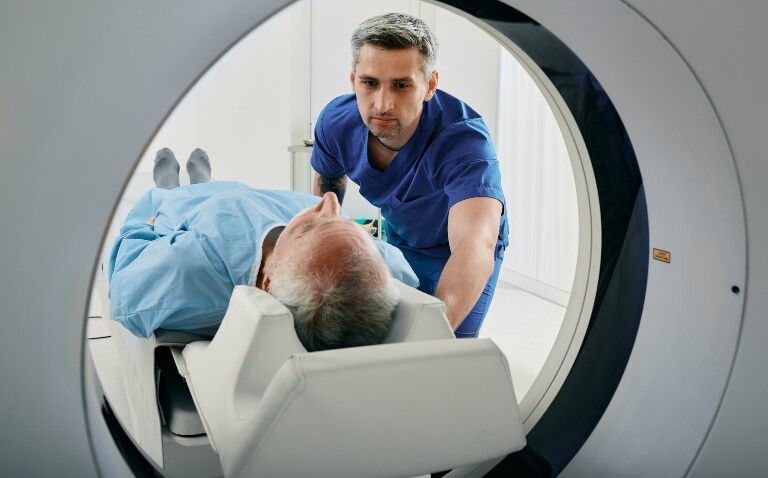
Dr Pankaj Garg, lead researcher of a recent registry study on 4D flow cardiac MRI, explains how the technique clarifies ‘grey zone’ aortic stenosis and visualises complex flow patterns, offering more accurate predictions than traditional ultrasound methods. This breakthrough could enable earlier and more precise identification of patients who need valvular intervention, potentially improving outcomes and saving lives.
Aortic stenosis is a common, critical valvular pathology but it is not always a straightforward diagnosis.1 Echocardiography is used as first-line assessment, yet eccentric jets – where the stream of blood exiting the heart is directed off-centre by a valve deformity – along with limited acoustic windows and clinical-echo mismatch leave ‘grey zones’ where the next step in management is uncertain.1–3
Why flow patterns matter after intervention
In transcatheter aortic valve implantation and replacement (TAVI/TAVR) or surgical aortic valve replacement (SAVR), selecting the device type, size and positioning to normalise flow may improve symptoms, remodelling and durability. Markers such as flow displacement, reversal ratio and energy-loss indices offer early mechanistic readouts of whether healthy flow has been restored.4
Abnormal patterns such as eccentricity, vortices and systolic flow reversal raise the energetic price the ventricle pays and influence remodelling. Prosthesis design and implantation technique shape these patterns, suggesting a therapeutic goal of restoring physiological flow, not merely enlarging the orifice.4
An important tool in assessing aortic stenosis
Four-dimensional flow cardiac magnetic resonance imaging (4D flow CMR) is a time-resolved map of blood flow.2,4 It measures speed and direction at thousands of points in the heart and great vessels, and blood flow velocity is measured by encoding motion in all three spatial directions over time, capturing dynamics throughout the cardiac cycle (i.e., 3D + time = 4D).2,4
4D flow CMR can play an important clinical role in aortic stenosis because the scan can locate the fastest part of the jet in three dimensions, and the peak velocity is effectively angle-independent.1,2 The flow pattern – clean streaming, swirling or systolic reversal – is visible in a way that a single ultrasound beam may miss when the window is limited or the jet is eccentric.2,4
Real-world clinical value of 4D flow CMR
Research conducted by the University of East Anglia in partnership with the University of Sheffield has shed light on the utility of 4D flow CMR in predicting which patients will ultimately proceed to valve intervention in aortic stenosis.
In the single-centre, pragmatic PREFER-CMR registry of 30 consecutive patients who underwent both transthoracic echocardiography and 4D flow CMR, 17 patients (57%) proceeded to valve intervention over a mean follow-up of eight months, while 13 patients (43%) were managed conservatively.1
The cohort reflected day-to-day practice: atrial fibrillation was not an exclusion, the median interval between the two modalities was three months, and 27% had CMR before echocardiography. Patients who ultimately underwent intervention were younger (72.1 ± 6.8 vs 79.9 ± 5.1 years).
Crucially, the 4D-flow peak aortic jet velocity separated the groups more clearly (4.2 ± 0.7 m/s in those referred vs 2.7 ± 0.7 m/s in those managed conservatively; p<0.0001) and independently predicted intervention on Cox analysis (hazard ratio (HR) 2.51 per 1 m/s increase; p<0.01), accounting for virtually all of the model’s explanatory power.
By contrast, the Doppler continuous-wave peak velocity was lower on average and, although it differed between groups (3.4 ± 0.7 vs 2.6 ± 0.5 m/s; p=0.0025), it did not independently predict intervention (HR 0.54; p=0.76).
Agreement analysis showed a systematic Doppler under-read versus 4D flow with a mean bias of −0.5 m/s (95% CI −0.79 to −0.12), moderate correlation (R=0.55) and limits of agreement from +1.3 to −2.2 m/s.
A receiver-operating curve-derived threshold of >3.5 m/s on 4D flow provided the most practical cutoff point for identifying patients who were referred for TAVI/TAVR or SAVR in this real-world cohort.
Previous validation provides confidence
Before drawing conclusions from the registry signal, it is reassuring to note that 4D flow has been validated previously against the gold standard invasive catheter assessment.
In a prospective study led by Archer and colleagues, 4D flow-derived gradients agreed more closely with invasive measurements than echocardiography, largely because 4D flow identifies the true vena contracta plane and is not constrained by beam-angle assumptions.2
Their work also moved beyond valve narrowing to the energetic cost of pumping, linking haemodynamics to how patients feel and recover.
Using 4D-derived flow energetics, the study showed a relationship with six-minute walk performance and found that these metrics tracked reverse remodelling after valve replacement more closely than traditional thresholds, explaining why two patients with similar Doppler numbers can feel and recover very differently.5
Practical considerations for clinical use of 4D flow CMR
When to order 4D flow CMR
Request 4D flow when echo findings are borderline or discordant with the clinical picture, particularly with suspected eccentric jets or when symptoms seem more severe than the Doppler suggests.1
Setting it up
If aortic stenosis is under consideration, set the velocity-encoding (VENC) to 400 cm/s as the default to minimise aliasing of high-velocity jets. If velocity aliasing persists, increase the VENC; if the signal looks too faint, reduce slightly – but start at 400 cm/s for aortic stenosis and adjust from the initial baseline measurements.
How to report it
Keep the report decision-focused: state the 4D-flow peak velocity, reconcile it with the Doppler value and add a clear interpretive line on whether the overall picture supports referral for transcatheter or surgical replacement. This reduces repeat testing and gives the heart team a shared, objective anchor.1
The bottom line
When echo numbers and the patient’s story do not align, 4D flow CMR offers a clearer clinical picture. Use it deliberately in ‘grey zone’ cases; set the VENC to 400 cm/s when aortic stenosis is suspected, and report with a line that informs the decision.
What’s needed next?
Larger, multicentre prospective studies should confirm 4D-flow peak-velocity thresholds across vendors and sites and relate them to concrete health outcomes, as well as clinical decisions. Automated pipelines and simple quality assurance steps will support consistent delivery.1,4
Randomised diagnostic pathways in discordant aortic stenosis, and trials that pair clinical outcomes with 4D-flow markers of ‘flow restoration’, will inform whether using these data to guide device selection and technique translates into better remodelling and longer-lasting valves.4
As the evidence base grows, the field will shift from measuring aortic stenosis more accurately to treating flow more effectively.
Author
Pankaj Garg MD MRCP PhD
Associate professor in cardiovascular medicine, University of East Anglia, and honorary consultant cardiologist, Norfolk and Norwich University Hospitals Foundation Trust, Norwich, UK
References
- Grafton-Clarke C et al. Four-dimensional flow provides incremental diagnostic value over echocardiography in aortic stenosis. Open Heart 2025;12(1):e003081.
- Archer GT et al. Validation of four-dimensional flow cardiovascular magnetic resonance for aortic stenosis assessment. Sci Rep 2020;10(1):10569.
- Grafton-Clarke C et al. Validation of aortic valve pressure gradient quantification using semi-automated 4D flow CMR pipeline. BMC Res Notes 2022;15(1):151.
- Garg P et al. Restoration of flow in the aorta: A novel therapeutic target in aortic valve intervention. Nat Rev Cardiol 2024;21(4):264–73.
- Elhawaz A et al. Left ventricular blood flow kinetic energy is associated with the six-minute walk test and left ventricular remodelling post valvular intervention in aortic stenosis. Quant Imaging Med Surg 2021;11(4):1470–82.